“He used to tell me everything. Now I get ‘fine.’”
Parent-child connection

Burned out, no time, and a kid who gives you one-word answers? You yelled again this week and felt terrible about it? You are not failing. You’re running on empty, and that’s where your snapshot starts.
Your first check-in takes less than 10 minutes. No credit card needed.
Built by founders, psychologists, and scientists from
The case for closeness
You’ve googled it at 11 p.m. You’ve asked a friend and gotten a shrug. Family connection is the strongest protective factor in adolescence, and nobody ever measured it. Now you can see where your family sits compared with families who have a child the same age.
Resnick et al., JAMA (1997) · 90,000+ adolescents
Why we built this
A screen is hard to compete with, but your full attention is the one thing that can win that battle, and it takes less than you’d think. Instead of blocking and filtering, we measure how close you are, then give you an evidence-based recommendation to get closer this week. Often five minutes.
Sound familiar?
“He used to tell me everything. Now I get ‘fine.’”
Parent-child connection
“The meltdowns are running our whole house.”
Child’s emotional well-being
“Something’s happening at school and she won’t say what.”
Child’s emotional well-being
A divorce, a move, a new school—or simply keeping a good thing good. All of it moves the same three signals.
What we measure
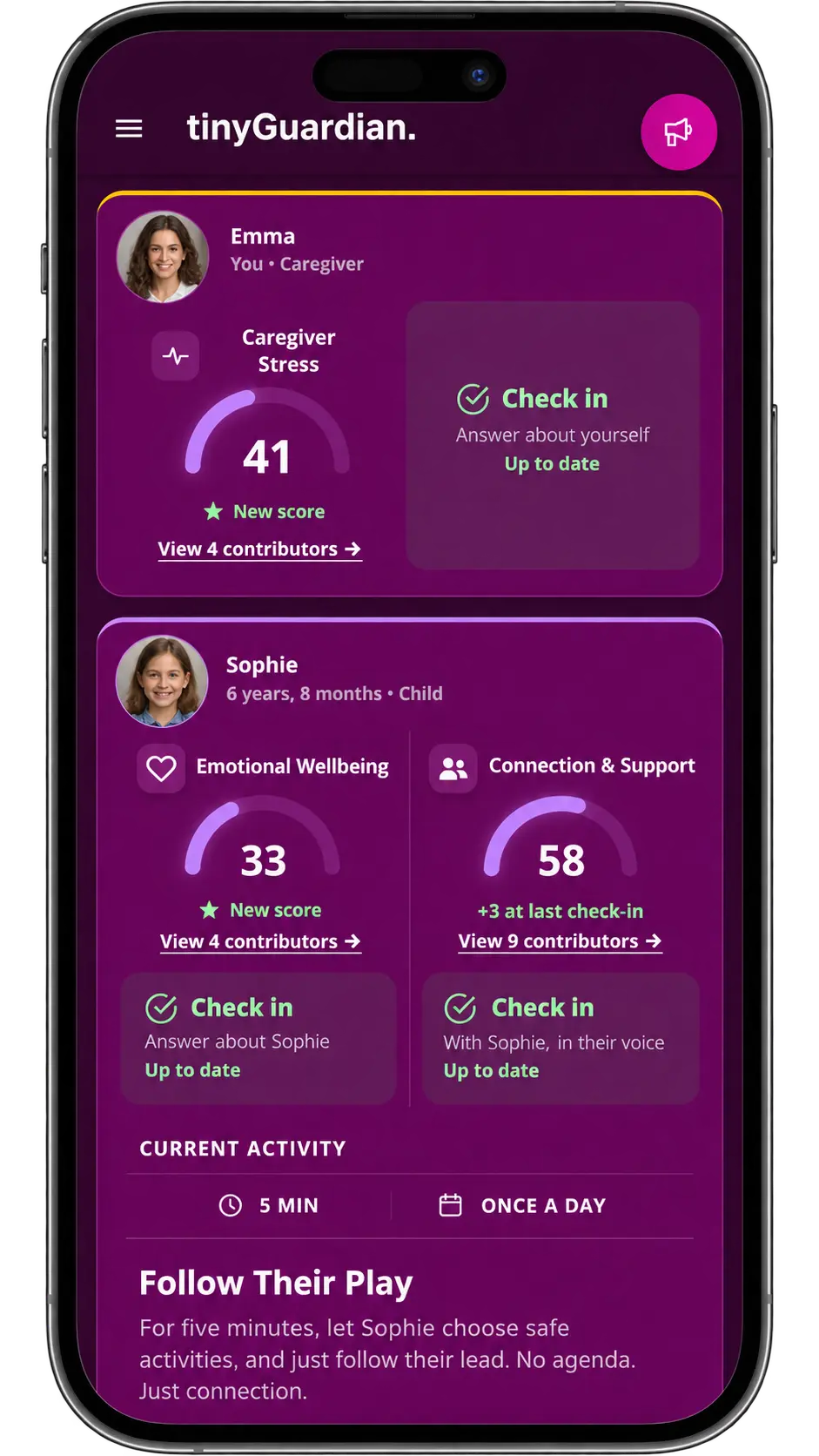
Every check-in scores three signals you can watch move.
Signal 01
How much room you have right now. A tired parent isn’t a bad parent. Measured honestly, never graded.
Never gradedSignal 02
Your child’s own read on how ready they feel for the world—in their own words, not inferred from behavior.
Signal 03
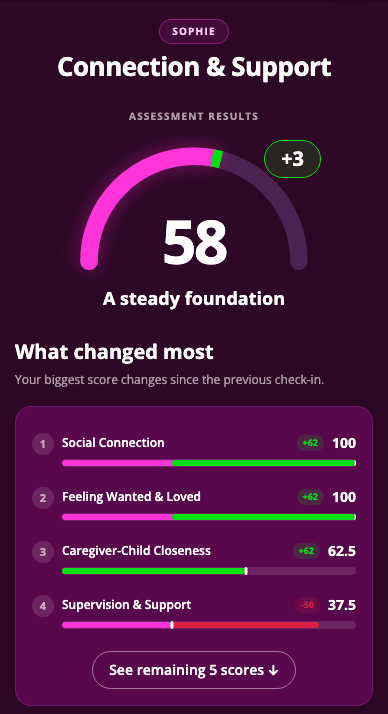
Closeness between you, benchmarked against families with children the same age.
How it works
A warm, age-appropriate check-in you answer side by side.
9 areas scored, three signals resolved, benchmarked by age band—private to your household.
Not 400 articles. One evidence-based activity, sized for a real week.
Closeness stops being a feeling you hope you have and becomes a line going up.
What this costs
Pediatric waitlists run for months. Insurance says no more often than yes. The care is real—the access isn’t.
Evaluation and treatment
$4,370–$12,200per year, per child—if you can get an appointment.
tinyGuardian · Per family
No waitlist, no referral. Start tonight, cancel anytime.
tinyGuardian is preventive, not treatment, and doesn’t replace a clinician when one is needed.
The evidence
Resnick et al., JAMA (1997) · Add Health
For you: the relationship you already have is one of the most important protective influences in your child’s life.
JAMA Pediatrics (2025)
For you: closeness built early may keep paying off as a child grows.
CDC (2019)
For you: risk isn’t only about what a child is exposed to. It’s also about what they’re anchored to.
U.S. Surgeon General’s Advisory (2024), reporting APA data
For you: why we measure your stress level instead of assuming it. 15 minutes is a design constraint.
tinyGuardian internal data
For you: the first snapshot is designed to surface something useful early enough to act on it.
tinyGuardian helped us reconnect with our son in a way therapy and school conversations hadn’t—he finally opened up to us.
For partners
Churches, schools, employers, health plans, therapists, and researchers license sign-up packs for the families they serve.
See how it works for the families you serve—in a 15-minute call.
Who’s behind it
Product and engineering leaders from KAYAK and Insurify—advised by psychologists and Experts who design and validate tools that measure psychological traits, abilities, and behavior. from Harvard Medical School, UCLA, and the University of Minnesota.

Clinical Psychology · Harvard Medical School

Clinical Psychology · UCLA

Psychometrics · University of Minnesota
Questions
The score isn’t a verdict on your child or on you—it’s a way to notice a drift you’d otherwise only feel. Parents told us the check-in itself was where the value was.
No. No location, no filtering, no reading messages. We measure the relationship—not your child’s devices.
Your stress level is never graded or compared with other parents. A hard month gets you a shorter list, not a longer one.
Encrypted, never sold. Benchmarks use de-identified aggregates. Export or delete everything in one tap.
Roughly 2–12, with more age bands in development.

See where your family stands tonight—then get closer, 15 minutes at a time.
About 10 minutes. No credit card needed.